
Words and Numbers
The Uncertain Origins of Gematria
The technique of bible interpretation known as Gematria has always been controversial. Its opponents accuse it of being a fanciful, quasi-mystical technique that is so flexible in its application that it can be used to prove anything. They argue that gematria has no place in bible interpretation; it is a foreign system that cannot be applied to the Hebrew language and that any connections it appears to draw between words in the bible are arbitrary and coincidental.
In this article I am not going to argue whether the interpretations reached through gematria are right or wrong; that is a question of belief, not science. But I think it is interesting to look at where gematria came from, whether it does indeed have a connection to the Hebrew language and how it became popular in certain mystical and spiritual circles.
Gematria is a technique that compares the numerical value of two or more words to each other. In biblical Hebrew there were no symbols for numbers, instead the number was written out as a word: one, two, three etc. Eventually, however, letters became used as numbers; the first letter in the alphabet was the equivalent of our number one, the second letter was two and so on, up to number 9. The next ten letters represented 10, 20, 30 and so on up to 90. The following letters represented the hundreds, but since there are only 22 letters in the alphabet, as the illustration below indicates, 400 was as high as the system could go

The basis of Gematria is that there is a connection between words which have the same numerical value. So, for example, the fundamental Jewish religious declaration is that God is One. Adding up the numerical value of the three letters in the Hebrew word for One gives a total of 13. 13 is also the sum of the letters in the word that spells Love. So, according to gematria, God is Love. Quite an important theological idea.
The word gematria is not Hebrew. It is Greek. It probably comes from the same root as the word geometry, though some connect it with the Greek word meaning grammar. Like the Hebrews, the Greeks used the letters of their alphabet to denote numbers. The Greeks thought that seeing a weasel in a dream was a bad omen, because the numerical value of the Greek word for weasel is the same as the word for a lawsuit.
There was, however, a difference between the Greek and Hebrew systems. As we saw above, the numbers in the 22 letter Hebrew alphabet only go up to 400. The Greek alphabet has 24 letters, so their alphabetic numbers can go up to 600. But the Greeks weren’t satisfied with this. They wanted their number system to go all the way up to 1000, or at least 999. So they imported three letters from the old Phoenician alphabet to signify 700, 800 and 900. The Hebrews did not do this.
The Hebrew and Greek alphabets are very similar- even the names of the letters are almost the same, aleph, bet, gimmel, dalet in Hebrew, alpha, beta, gamma, delta in Greek. Phoenician was the linguistic ancestor of both languages. So, when it was discovered that the Greeks had imported three Phoenician letters into their number system, and the Hebrews had not, a scholarly argument broke out. Did this mean that the Hebrews had copied the Greeks, and were just not smart enough to understand that the Greeks had included Phoenician letters to make the numbers up to 900? Or did the Greeks copy the Hebrews, and improved on their system by adding in Phoenician letters? Since the evidence suggests that both the Hebrews and the Greeks started using letters to represent numbers at around the same time, during the 4th century BCE, it is not easy to work out who copied from whom.
But this gives rise to another problem. If the earliest evidence of Hebrew letters being used as numbers is the 4th century BCE, where does this leave the technique of using gematria to interpret the Bible? Nearly all the books of the Bible had been composed by this time, and if the authors of the various books did not know that letters were also numbers, how could they have inserted numerical, gematria clues and connections into their texts?
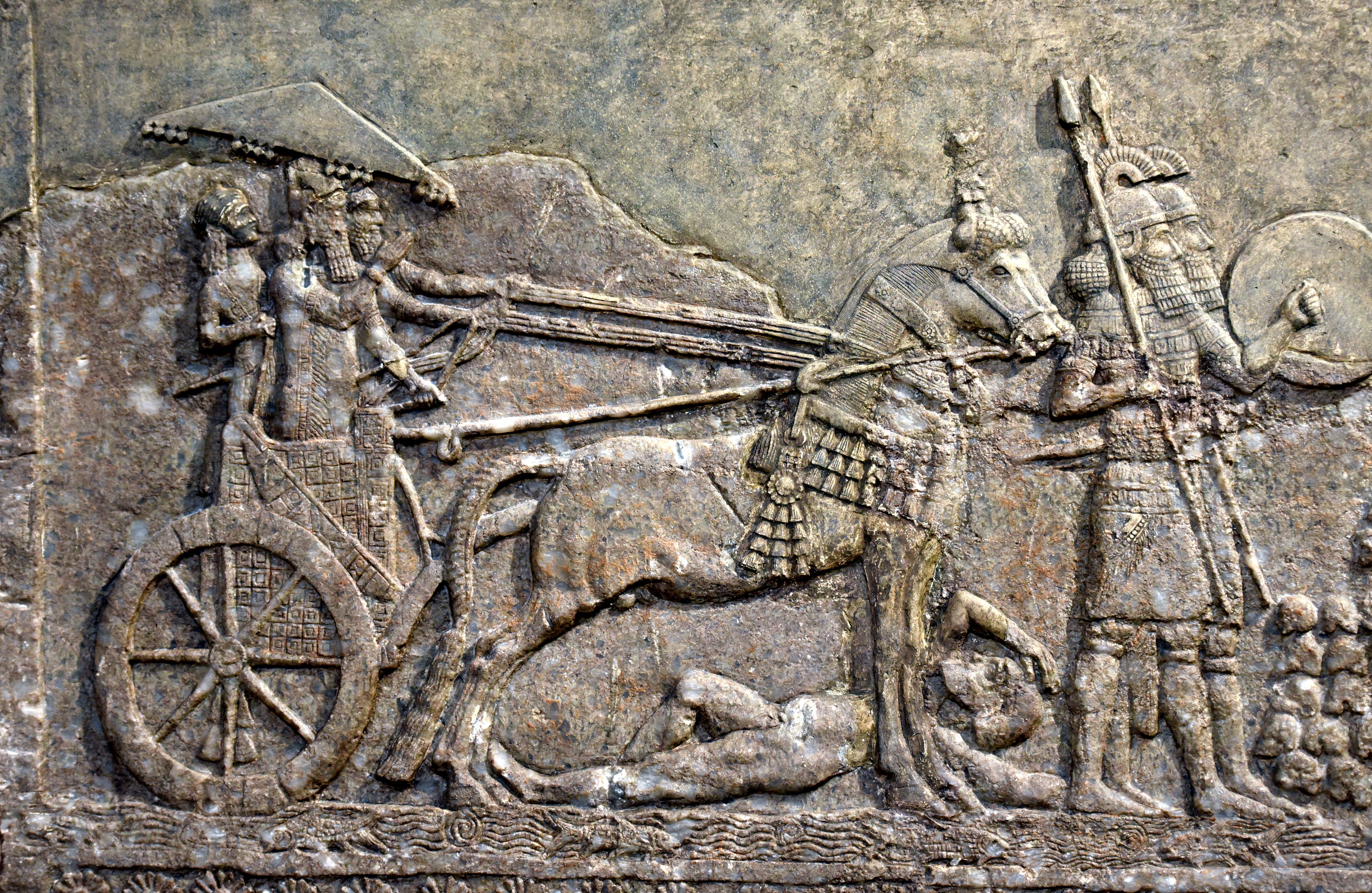
Those who believe that the gematria can be used in biblical interpretation have a simple answer to this. Just because there is no evidence that letters were used as numbers before the 4th century BCE, doesn’t mean that they weren’t. 400 years earlier, in the 8th century BCE, the Assyrian king Sargon II (722-705 BCE) ordered that the circumference of the wall around the town of Khorsabad was to be 16,283 cubits, to correspond to the “number of his name”. Using letters as numbers seems to go a lot further back that the 4th century BCE.
Advocates of biblical gematria also point to a couple of examples from the bible text itself that support their point of view. In Genesis, Jacob’s seventh son was called Gad. The numerical value of Gad in Hebrew is seven. Gad himself had seven sons. (This is not the same as the old aristocratic tradition of naming sons Sixtus or Septimus. Gad’s adoptive mother, Leah, hadn’t run out of names; she had a good personal reason for giving him that name).
Similarly, when the prophet Jeremiah, for reasons we no longer understand, wanted to allude to Babylon cryptically, rather than calling it by its Hebrew name of Babel he called it Sheshek. He was using a variation on Gematria, known as Atbash, where the first letter of the alphabet is replaced by the last, the second letter from the one from last and so on.
As time went by, gematria became increasingly popular and the techniques by which words could be associated with each other, or with different ideas, became more sophisticated and imaginative. Acrostics and abbreviations could be used as the basis of calculations, and if the sum of the letters in a word fell one short of the desired total, the word itself could be counted alongside the letters to increase the value by one.
The Sefer Yetzirah, or Book of Formation, which probably dates to the 10th century, developed mystical and meditational techniques for combining and permutating letters. They became the bedrock of later mystical traditions, in which phrases or whole sentences from the bible were often computed as values then used to support mystical ideas, expressed as numbers.
From the Greek, gematria found its way into Christianity and was later adopted by renaissance scholars and practitioners of the occult. Its magical, superstitious character gave it an appeal that today has exploded, way beyond its original Hebrew or Greek origins into a sort of pop-gematria, and not necessarily for the best. Those who appreciate the technique’s ancient theological and mystical potential might feel it has become somewhat devalued. As it is possible to calculate the value of words in any language, by giving each letter a number, gematria has become a panacea for anyone so inclined who is hoping to uncover deeper truths, predict the future or validate ideas. There are online calculators that have taken the drudgery out of finding the value of any word: one English gematria calculator bizarrely introduces itself by proclaiming that the gematria of Hello is Devil, (perhaps to remind us that we need to be careful in what we say).
Yet we don’t need online gematria calculators, or the gematria indices and lookup tools that preceded them. AI will calculate the values for us. I asked ChatGPT what the numerical value is for ‘how do I finish this article?’ The answer, I was told, is 1478.
1478 = Year of Spanish Inquisition.
Cheers,
Martin AKA 75 = A"H. Fortunately not dead yet.
Great article. Thx.