
When Religion met Science
Isaac Lampronti and his Modern World
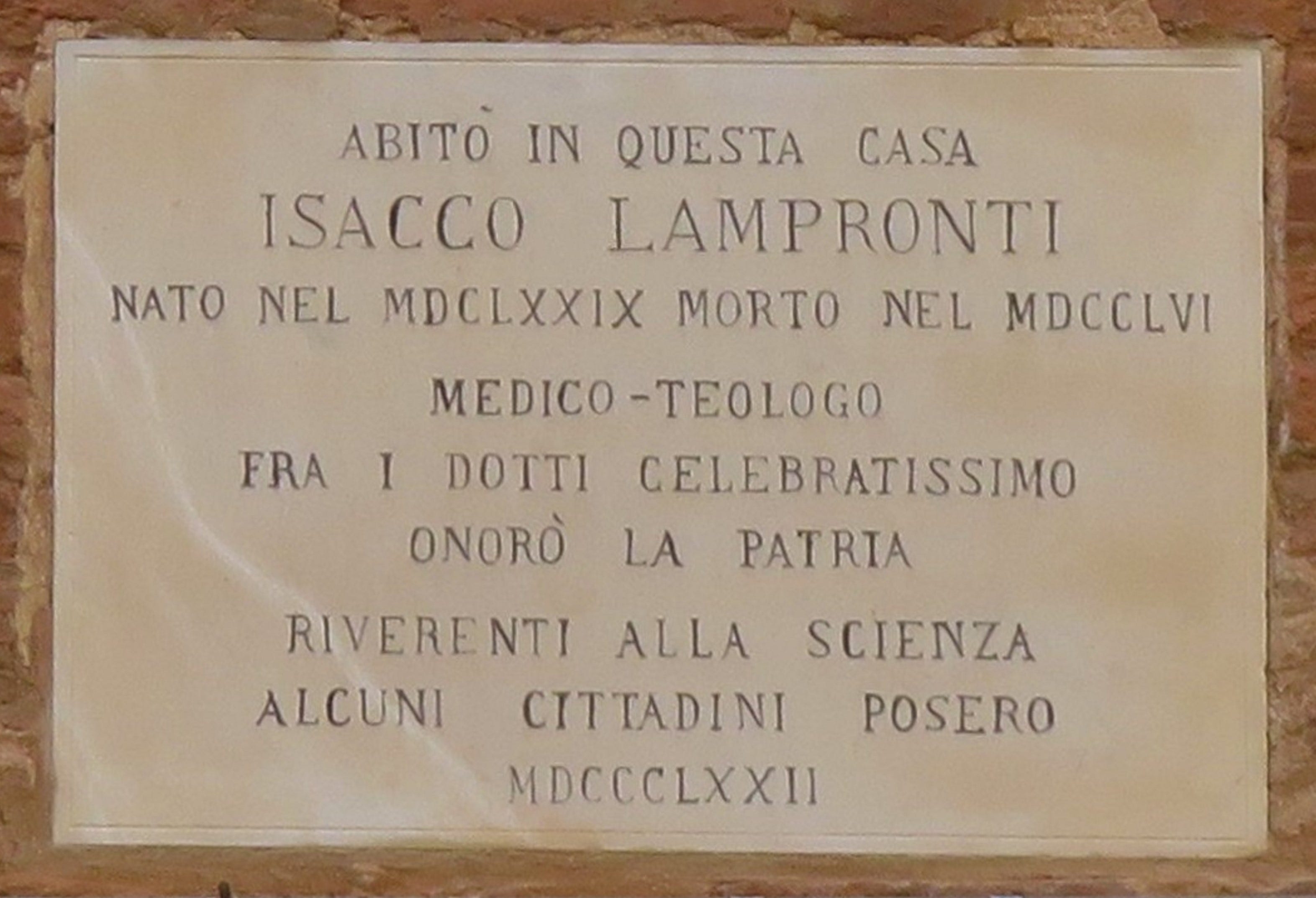
The dawn of the modern age saw new scientific discoveries challenge the religious view of how the world worked. Instead of relying on belief and faith, scientific thinkers developed theories based on their observations and tested these theories through experiment and calculation. Although, as individuals, many of them tried to cling to the old ways as well as the new, as scientists, they were not interested in what the Bible or a member of the clergy had to say, they were only concerned with matters that they could prove to be correct.
The threat of science to religion was as acute in the Jewish world as elsewhere. Some rabbis refused to accept the findings of science at all. They insisted, for example, that Jewish tradition was correct in asserting that the kidneys were the seat of our emotions, or that lice were spontaneously born out of mould and therefore were not animals.
These rabbis justified their views by claiming that science was only capable of scratching the surface of human knowledge, whereas religious tradition was infinitely deeper and more profound. They pointed to a discussion in the Talmud in which the ancient rabbis had retracted their view that the planets revolved against the backdrop of a stationery sky, in favour of the opinion of the ‘sages of the world’, who maintained that it was the sky that moved, carrying the planets with it. By the 16th century it had been proved that the planets did in fact revolve and that the Talmud’s original opinion had been right. It had been a mistake, the traditionalists said, for the Talmud to abandon religious tradition and pay attention to the ‘sages of the world’.
Other Jewish thinkers disagreed, particularly those who had studied medicine. They accepted that the Talmud might have been right about the planets but that was an exception, they insisted that, generally, modern science understood more about how the world worked than religious tradition. They pointed to the recipes for medicines in the Talmud, arguing that many were nothing more than superstition. To cure a nosebleed, for example, the patient was instructed to find a priest named Levi and get to him write his name backwards. If he couldn’t find a priest with the name of Levi he could cure his nosebleed by finding an ordinary person and getting him to write “I am Pappi Shayla bar Summakei” backwards. This, the modernising rabbis said, was superstition. There were now more effective, scientific, remedies for nosebleeds.
