
Should the Bishop Pay?
Ambrose and the synagogue burning in Callinicum
Round about the year 388 a Christian mob, led by their bishop, attacked and burnt down a synagogue in the town of Callinicum, in Mesopotamia. A group of monks stole the synagogue’s valuables and for good measure also destroyed a neighbouring chapel belonging to a gnostic sect, neither Christian nor Jewish. The destruction of a synagogue was not an uncommon event, but this one became the most famous of all similar incidents, largely due to the intervention of the theologian and bishop of Milan, Ambrose.
There is no record of how the Jews in the town responded, if at all and the immediate reasons for the mob turning on the synagogue are no longer understood. It is likely that that this was not an isolated event in Callinicum; that it resulted from existing tensions and strongly felt disagreements between the Jewish and Christian communities in the city. Each religion was engaged in its own battle; it was less than a century since Christianity had been transformed from a persecuted faith to the official religion of Rome and, for its preachers, the challenges involved in imposing Christian beliefs on the idol-worshipping, hedonistic Roman Empire were overwhelming.
Judaism meanwhile was engaged in a struggle for its own survival. Three centuries had passed since the destruction of the Temple in Jerusalem, the ancient heart of the Jewish religion, and the scholars in Babylon and Roman occupied Palestine were increasingly conscious that it was unlikely to be speedily rebuilt. Trying to reconstruct their faith they spent their lives debating intricate details of ritual and law. Their discussions eventually resulting in the Talmud, the vast compendium which served as the vademecum for the Jewish faith during its long exile.
Distracted by their own problems, each community resented the other. Jews regarded Christians as having added to their difficulties through their appropriation and corruption of Judaism. Christians, who considered Jews to be wilfully blind to the truth, regarded them as obstacles in their mission to spread their faith throughout the Roman Empire. It is not surprising that when the two communities lived in close proximity, as they seem to have done in Callinicum, relationships between them were poor.
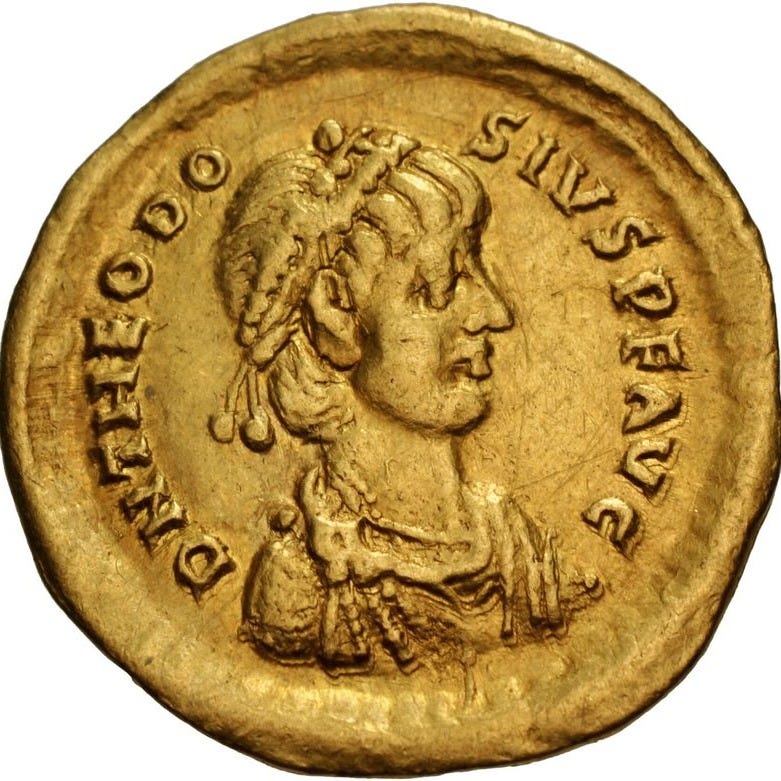
When the synagogue in Callinicum was burnt down, the Roman governor ordered the offenders to rebuild it, and told the bishop who had led the attack to pay for the rebuilding out of his own funds. The bishop complained to the Roman emperor, Theodisius, but he merely confirmed the governor’s decree. Somehow the matter came to the attention of Ambrose in Milan, one of the most prominent and influential early Christian leaders, who would eventually be canonised as a saint. Ambrose, who had good connections with Theodosius, decided to take the matter into his own hands.
Ambrose wrote a long letter to Theodosius. He began by claiming that the report of the burning must be false, or at least exaggerated, because priests and bishops are anxious for peace and are only moved to violence if provoked by an offence against God or an insult to the Church.
Perhaps aware of the weakness of his argument, Ambrose then changed tack, asking the emperor what would happen if the bishop did as he had been instructed and arranged for the rebuilding of the synagogue. Would he not, Ambrose asked, have betrayed in his faith as a Christian, by building a place of worship for a heretical religion? And, if he had refused to obey the emperor, what then? Would he not have been executed? Furthermore, what might happen if the bishop had not rebuilt the synagogue but other people in the town decided to do so, in order to appease the Jews? Wouldn’t the Jews erect a sign on the front of their rebuilt synagogue, stating “The Temple of Impiety, built from the plunder of Christians.”
Trying to drive his point further, Ambrose then denied that the burning of the synagogue was a crime at all. In fact, if anyone was a criminal, it was himself because he should have burnt down the synagogue in Milan but had been too lazy to get round to it. Now he was unable to, because heaven had stepped in and the building was in a state of collapse. Heaven’s intervention proved, he said disingenuously, that all synagogues should be destroyed.
Finally, he cited a list of churches that had been burnt by the Jews during the recent reign of Julian the Apostate, when the Church had briefly been outlawed in Rome (there is no evidence from any other source that churches were burnt during this time).
As for the emperor, Ambrose warned, he should take care. Had not a previous emperor, Maximus, been overthrown because he ordered Christians to rebuild a synagogue they had destroyed in Rome? (Historians are certain that is not the reason Maximus was deposed).
Ambrose’s appeal fell on deaf ears. The Emperor neither replied nor cancelled his decree. But that was not the end of the matter. A few months later Ambrose wrote to his sister, a nun named Marcellina. He told her that the previous Sunday he had preached a sermon in the cathedral in Milan, taking as his theme the prestige of the church and the reproach of the synagogue. The Emperor, who was visiting Milan, was among the congregation. When Ambrose stepped down from his pulpit the Emperor asked whether his words had been directed at him. Ambrose replied that they had indeed been directed at him, and that he had preached in this way in order to save the Emperor’s soul; the idea being that if Theodosius did not take care of the Christians then God would not take care of him.
Ambrose’s reply had the desired effect. The emperor said that perhaps he had been a bit harsh ordering the synagogue to be rebuilt. But that is all he said. Ambrose stood, waiting. We can imagine the congregation growing restless, shuffling in their seats as a stand off developed between the two men. Eventually Ambrose spoke again. He asked the Emperor to set his mind at ease. The Emperor understood the threat: cancel the decree or be excommunicated. It was no idle threat, a short while later Ambrose did indeed excommunicate him over a separate matter; a massacre that had taken place in Thessalonica. But here in Milan the emperor had no intention of falling out with Ambrose. He cancelled the decree. The bishop did not have to rebuild the synagogue. Though Theodosius did score a partial victory. Five years later he issued an order to punish any Christian who attacked or destroyed a synagogue.

This episode, along with many others, is described in James Parkes’s 1961 book The Conflict of the Church and the Synagogue. We only has to read it to appreciate that, for all his hostility to Jews, Ambrose was by no means the worst offender in ancient times.
The Jewish response during this period is less certain. Although no evidence has survived to support Ambrose’s claim. that they had destroyed churches during Justin’s brief reign, this doesn’t mean it could not have happened. Justin had tried to overturn his uncle Constantine’s decree that Christianity was to be the official religion of Rome. The Jews may well have taken advantage, even though they were few and lacking in power.
And even if they had not retaliated violently against the destruction of their synagogues, they did have the power of words. The Talmud does not say much about Christianity, but its few short references indicate that the antipathy between the religions ran both ways. The various Talmudic references are discussed in Peter Shäfer’s masterly study, Jesus in the Talmud. But we don’t find these references in most copies of the Talmud today. They were deleted, excised from the text shortly after the invention of printing. By the command of Christian censors, who worked in the printing presses, under the direction of the Church. And that is another story.
"vademecum"
Made me giggle.
Cheers,
mb