
Moses's Horns
A Tribute, or Denigration?
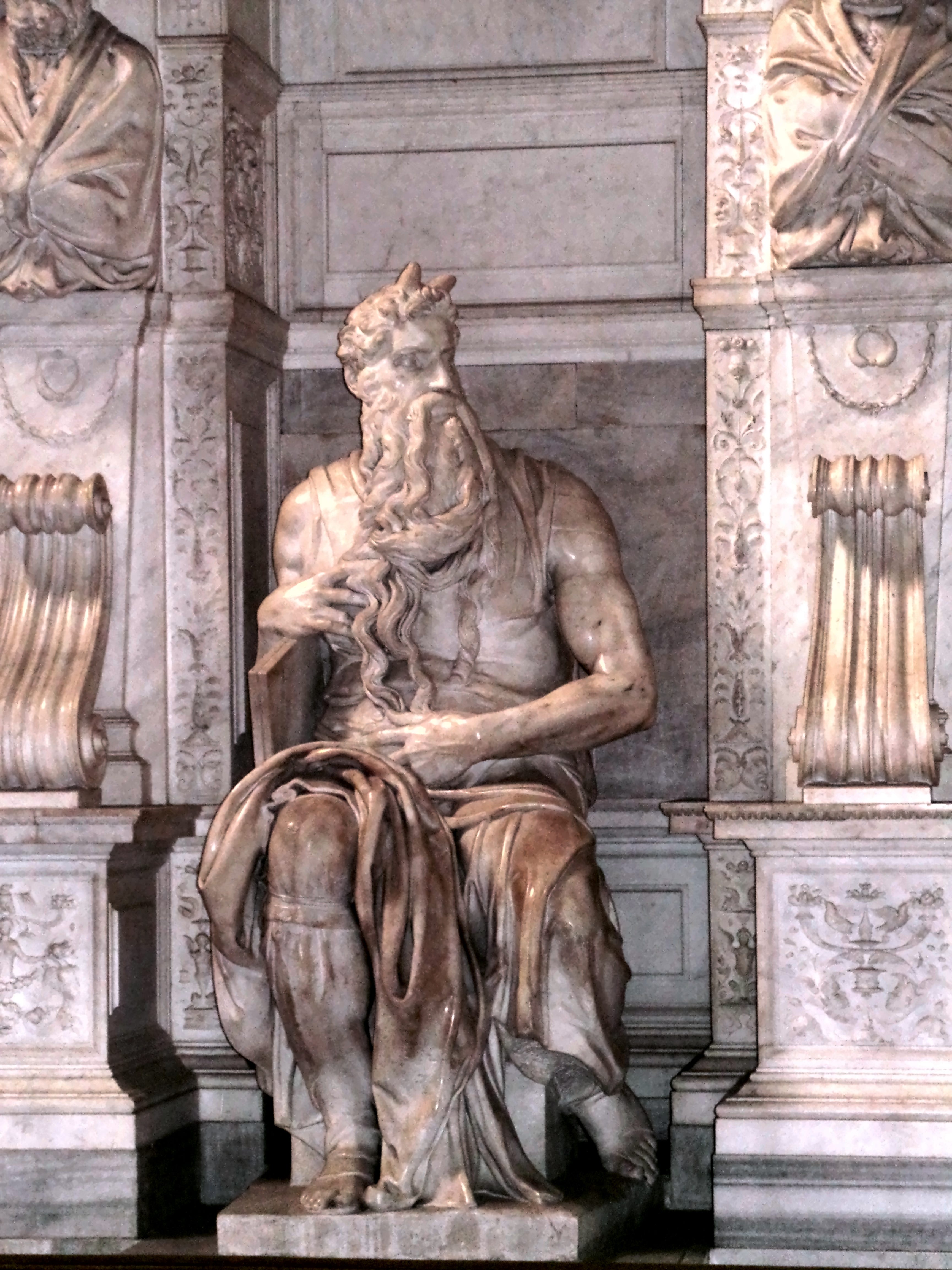
In 1553, the Italian artist Ascanio Condivi, a student of Michelangelo, published a biography of his teacher. He was full of praise for all of Michelangelo’s works, particularly for the statue of Moses that formed the centrepiece of the tomb constructed in Rome for Pope Julius II. Condivi noted that ‘The face is full of animation and spirit, apt to inspire both love and terror . . . Following the customary descriptions, he has the two horns on his head, not far from the top of his forehead.’
Condivi’s almost parenthetic remark about the two horns on Moses’s head does not seem to do justice to a topic that has generated so much scholarly attention, debate, antisemitic diatribe and rage. But Condivi didn’t think the protuberances were particularly important. Michelangelo, he had written, was simply ‘following the customary descriptions.’
Moses’s horns, on one of the world’s most famous statues, sculpted by the Renaissance’s outstanding artist, are, to modern sensibilities, both intriguing and shocking. Yet Michelangelo was in no way original in crowning Moses with horns. Artists had been doing so for the past 500 years. Ever since the 11th century in fact, when an illuminated Anglo Saxon paraphrase of the Bible appeared in England, containing dozens of illustrations of Moses sprouting horns. Nor was this Bible the first to claim that Moses was gehyrned, or horned. The idea of Moses having horns goes all the way back to the Vulgate, the authoritative Latin translation of the Bible produced in the 4th century by the Christian theologian, Jerome.
Over time, the belief that Moses had horns on his head took on a new dimension. From being a feature unique to Moses, people began to believe that those who followed his teachings, the Jews, also had horns. These horns, people declared, proved that Jews were demonic, in league with the devil, who was himself famously horned. The idea of the horned Jew added fuel to the fires of antisemitism; proof that the standard accusations of well poisoning, ritual murder and plague spreading, were indeed true. Even today, some people believe that Jews have horns. Recently, some anti-Israel protesters have carried images and effigies of Jewish politicians bearing horns.
Jerome’s translation that left Moses with horns on his head was the result of his attempt to be academically rigorous. Aiming to produce an accurate, reliable Latin version of the Hebrew Bible, he chose not to do as earlier translators had done and work from the Septuagint, the Greek translation from Hebrew that was regarded as canonical by the Church. Instead, he learnt Hebrew so that he could translate directly from the Bible’s original language.
His translation error, if that’s what it was, occurs towards the end of the Book of Exodus, shortly after the episode of the Golden Calf. Moses had ascended Mount Sinai, where he spent forty days communing with God, subsumed in mystical ecstasy and writing a new copy of the Ten Commandments, to replace the original tablets he had previously broken. When he came down from the mountain, the Bible says, he did not realise that something had happened to his face. He only realised something was wrong when he found out that people could not look at him, his visage was too bright. He had to put a veil over his face, so that he could engage in normal human conversation once again.
The root of the Hebrew verb, that the text uses to describe the change to his face, is based on the letters k-r-n. It occurs in several semitic languages to denote something that sticks out or protrudes, like a horn, but also, by extension, a ray of light or even a corner. And the reason that people could not look at Moses when he came down the mountain, the reason why he had to wear a veil, is not because his head had horns but because his face was casting out rays, shining with a divine radiance that had been bestowed upon him during his forty-day revelation. The context makes it clear: “Moses did not know that the skin of his face was k-r-n.” If the Bible had meant he had horns it would have said ‘the top of his head’, rather than ‘the skin of his face’.
Jerome’s mistake was an easy one to make, he didn’t appreciate that the Hebrew verb can either mean ‘to beam with rays’ or to ‘project horns’. Although, it has to be said, if he had translated from the Greek, like his Christian predecessors, instead of from the Hebrew, he would not have got it wrong. The Septuagint translates, correctly, ‘The complexion of his face became radiant.’
Jerome’s translation led directly to the myth that Jews have horns and the demonic associations that have persisted ever since. But we cannot blame Jerome. There is no reason to assume that horns must imply devilry. Horns in many cultures are symbols of power and strength. Ancient myths are full of horned gods, pans or satyrs. Alexander the Great is known in Islamic and Jewish folklore as du-karnayim, double horned, and this is a tribute to his strength, not an insult. The logic is quite straightforward; animals that have horns use them as weapons, hence they have come to symbolise strength. Indeed, the reason why devils and demons are sometimes portrayed as having horns is to indicate their diabolic power.
Yet, we do need to evoke mythology or paganism to show that horns are not necessarily a bad thing or a sign of evil. The Bible itself has a positive view of horns. Phrases like the horn of salvation and the horns of the righteous occur throughout the Bible. Having one’s horn raised is a metaphor for divine favour. And, of course, the shofar, the ram’s horn is the enduring and evocative symbol of Rosh Hashanah, the New Year. Horns, it turns out, are more on the side of the good than the bad.
Even more pointedly, if Jerome were here today, he might take exception to the claim that he was mistaken in his translation of Moses’s face being horned. He might point to a passage in a medieval Hebrew anthology, describing a mythical struggle between Moses and a gang of angels. Moses had gone to heaven to receive the Torah and the Ten Commandments; the angels were jealously trying to stop him from taking them down to earth: “Immediately, Moses summoned up power and might; he grew strong . . . a crown appeared on his head and horns burst out on his face. . . he began to fight like a goring ox.”[*] This, admittedly obscure, Jewish text is in no doubt that Moses had horns. And that he used them!
There are a few other passages like this; not many and all much later than Jerome’s translation, but they are enough to suggest that the idea of Moses having horns, even in the Jewish tradition, was not as problematic as it has been made out to be. It certainly was not a negative image.
Michelangelo knew nothing about the controversy that would break out over Moses’s horns; he was, as his biographer pointed out, merely ‘following the customary descriptions’. But there is no reason to believe that he perceived horns negatively. He may well have agreed with the author of the medieval Hebrew anthology, that Moses’s horns were not a devilish symbol, but rather, a sign of extraordinary status and strength. Jerome may have been wrong in his translation, but the idea behind it is perfectly sound.
[*] The Mythological Figure of Moses in Light of Some Unpublished Midrashic Fragments, Rimon Kasher, The Jewish Quarterly Review, Vol. 88, No. 1/2 (Jul. - Oct., 1997), pp. 19-42.
[*] The Mythological Figure of Moses in Light of Some Unpublished Midrashic Fragments, Rimon Kasher, The Jewish Quarterly Review, Vol. 88, No. 1/2 (Jul. - Oct., 1997), pp. 19-42.