
Born Before His Time
The pioneering work of Moses Hess
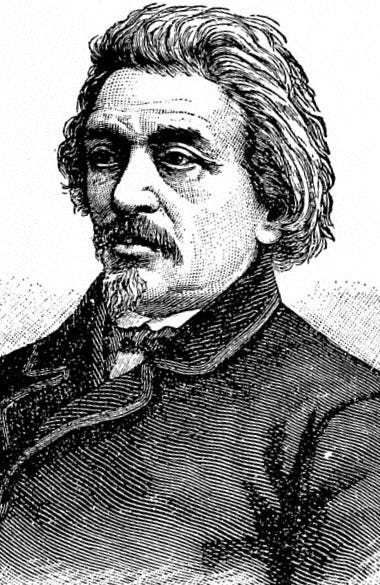
Theodor Herzl is rightly credited as the founder of Zionism. But, like many seminal political thinkers, the idea did not originate with him. One of those who preceded him, a man whose name is scarcely remembered, was Moses Hess. And Theodor Herzl was not the only political thinker to whom Moses Hess was relevant.
Moses Hess was born on January 21, 1812, in the German city of Bonn. His parents, both born into rabbinic families were devoutly religious, and Moses Hess received a traditional Jewish education. His father hoped his son would become a Talmudic scholar or even a rabbi. However, the world of religious scholarship held no attraction for the young man and, since he’d had no formal secular education, he was at a loss as to what to do with his life. He wrote in his diary that ‘I did not want to be a good-for-nothing, and therefore I became a writer.’
A writer? What education did I receive? None. Where did I study? Nowhere. What did I study? It does not matter. I nonetheless became a writer immediately, because I wrote more than I have ever read; hence I thought more than I had food for thought.
He educated himself, studying Latin, English, Mathematics and History and reading books by French and German writers. He took a particular interest in the writings of Spinoza and Heinrich Heine, considering their works to demonstrate how one could both be a Jew and live in the modern world. Unlike Spinoza and Heine however, he was still religiously observant, and considered neither man to be a suitable role model for himself. Spinoza was not suitable because, although he never formally renounced his religion, his philosophy had led him to be excommunicated by the Amsterdam Jewish community. Heine was even less suitable because, like so many of his generation, he had converted to Christianity to progress his career and his standing in German society. Heine however did espouse socialist ideas and was concerned with Jewish civil rights, topics that resonated strongly with Moses Hess. And Spinoza’s philosophical approach strongly influenced Hess as he developed his own thinking.
Moses Hess wrote two books while still in his twenties. The first, entitled Holy History of Mankind, a philosophical treatise advocating a socialist transformation of society, failed to have any impact. The second, The European Triarchy, calling for a radical alliance of France, Germany and England, fared little better. But it did help to spread his name in political circles.
As a result of his second book, Hess was offered a job as an editor at a new left-wing newspaper. The position launched his career as a journalist and political commentator. Even after moving to the more liberal environment of Paris, where Jews had equal rights and freedoms, he remained in contact with Germany’s radical political activists and thinkers. Among them was the young Karl Marx.
Moses Hess was overawed by Karl Marx. Marx was six years younger than him, yet the impression he made was staggering. In a letter to a friend, Hess wrote:
Dr. Marx— this is the name of my idol— is still a very young man, hardly 24 years old; but he will give the final blow to all medieval religion and politics; he combines deepest philosophical seriousness with cutting wit. Can you imagine Rousseau, Voltaire, Holbach, Lessing, Heine and Hegel combined— not thrown together— in one person? If you can, you have Dr. Marx.
Hess grew close to Marx and collaborated with him and Friedrich Engels in preparing their book, The German Ideology. He drifted away from Marx however, over the principles of communism. While accepting Marx’s argument that communism had to be based on class struggle and economic control, Hess added an ethical dimension, that society needed to be organised in a way that eliminated social conflict and the domination of one person over another. Marx attacked Hess’s ideas in The Communist Manifesto, though without mentioning him by name.
Hess’s concern for social improvement was particularly relevant to the Jewish world. He welcomed Jewish emancipation, but he saw a contradiction in it. He believed that Jews were a nation and were entitled to be treated as such, but he could not reconcile this with the assumption that, once emancipated, they would be equal with everyone else. The contradiction came into sharpest focus over the question of intermarriage.
Hess wanted to bring down the barriers between the religions and saw nothing wrong with intermarriage. But in those days, marriages could only take place in a religious environment, in the church or the synagogue; there was still no such thing as civil marriage. This meant that if a Christian and a Jew wanted to marry, one of them would have to convert to the other religion. And the possibility that the Christian would convert to Judaism was very slim — to do so would be to alienate themself from European society. Hess condemned this: “In Germany it is the state which forbids the Jew to marry outside his religion— unless he is ready to convert or (at least!) bind himself to agree that his children, born of such a mixed marriage, will be educated within the Christian Church.”
In 1862, Hess published his most important book, Rome and Jerusalem. It fundamentally changed his political priorities. The catalyst was probably the 1840 Damascus Affair, a blood libel in which the Jewish community of that city were held responsible for the disappearance of an Italian monk. “It reminded me, for the first time, in the midst of my socialist endeavours, that I belong to a miserable, defamed people, despised by the whole world, dispersed upon the face of the globe.”

Hess could see that the solution to antisemitic outbreaks like the Damascus Affair did not lie in emancipation or toleration. Rather, it was a problem faced by the Jewish nation. He took the concept of Jewish nationality for his premise in Rome and Jerusalem, considering it to be more fundamental than religion. The Jewish nation was, for Hess, the entirety of Judaism; religion was merely a set of beliefs and actions that helped Jews to preserve their nationality.
The study of the Torah became, in the Diaspora, the national cult of the Jews . . . . All the laws and regulations, both religious and juridical, which imbue all the corners and crevices of a Jewish person’s life, are aimed at preserving the integrity of Jewish life in the Diaspora . . . . Those who laugh at these regulations and deride them have no understanding of their deep patriotic meaning.
The solution for Jews therefore, argued Hess, lay not in civil emancipation or in religious tolerance. The solution lay in their reclaiming their rights as a nation. Tinkering with, or even refashioning the religion, as the Reform movement was doing in Germany, would not solve the problem; Jewish alienation could only be solved through national liberation. And, since the first requirement of national liberation was for a nation to dwell in its own land, Jews needed a land of their own.
Hess was pragmatic enough to recognise that life for Jews in Western Europe, even if far from perfect, was gradually improving. He could not envisage a mass emigration from France or Germany to Palestine, or anywhere else. But that did not matter:
Even after the re-establishment of a modern Jewish state, the relatively few Jews who inhabit the civilized countries of the West will continue to remain there. . . . Even at the time of the existence of the old Jewish commonwealth, many Jews always lived abroad. . . it does not really matter for the Jewish state how many members of the Jewish people will live at home or abroad. . . . There exists no civilized nation which does not have many members of its nation living outside its boundaries.
Moses Hess was a political theorist, not an activist. He never agitated for the establishment of a Jewish state, he almost certainly never knew or used the word Zionism. But he was aware of, and gratified by the attempts of others, most notably the Polish Rabbi Zvi Hirsch Kalischer, to promote Jewish emigration to Palestine. In Rome and Jerusalem Hess quoted at length from Kalischer’s book advocating the establishment of Jewish agricultural settlements in Palestine.
Like Hess’s earlier books, Rome and Jerusalem did not sell in vast numbers and was soon forgotten. 30 years later, when Theodor Herzl published The Jewish State, the work which launched the Zionist movement, he had never heard of Hess, or Rome and Jerusalem. When he did finally encounter Rome and Jerusalem, he said that, had he known of it, he would not have written his own book; Hess had already pre-empted much of his own thought.
Moses Hess is not the father of Zionism, that distinction belongs to Herzl. But he was a father of Zionism. His contribution helped prepare the ground and as such, he was a significant figure in the evolving ideal. Hess was a man ahead of his time. Who knows what he might have accomplished had he lived a generation later.