
A Very Modern Tyrant
Herod’s Insalubrious Career
Times change, history moves forward and the world progresses. Yet it seems that one type of person never changes. Tyrants, narcissists and bullies are much the same today as they were 2,000 years ago. At least, they are if we use the villainous King Herod, reviled in both Jewish and Christian tradition, as our example.
Born around 73 BCE, Herod was the son of an Arab princess and an Idumean father (the nation known in the Bible as Edomites). His father, Antipater, had served Julius Caesar as the chief administrator in Judea and Herod had grown up in a privileged and well connected home. His high level friends and contacts included Mark Antony, Caesar’s former lieutenant, who would become a member of the ruling triumvirate in Rome.
Many Idumeans, including Herod’s grandfather, had converted to Judaism a century or so earlier after their land was conquered by the Jewish Hasmonean dynasty. Herod was therefore a Jew but still regarded as an outsider by the majority of the Jewish population of Judea, particularly since he and his family worked with the hated Roman occupiers.
Herod’s career began in 46 BCE after he was appointed as governor of Galilee. He quickly achieved notoriety when he sent his troops to capture a group of Jewish guerillas who had been attacking villages across the border in Syria, running rings around the Roman troops stationed there and winning the support of the local Jewish population. When his troops brought the captured guerillas to him, Herod had them summarily executed. Herod was praised and rewarded by the Roman governor of Judea, but a popular backlash led by the victims’ families forced the Jewish puppet ruler, a man named Hyrcanus, to act. He had Herod charged with murder and demanded he appear in front of the Sanhedrin, the Jewish supreme court based in the Temple in Jerusalem.
Herod had no interest in legal niceties. He appeared before the Sanhedrin, but turned up at the hearing wearing purple, royal robes and accompanied by his personal army. He terrified the court into silence, was acquitted and left a free man. Only one member of the Sanhedrin, a Pharisee named Sameas, was bold enough to protest. He warned that one day Herod would rise to take his revenge on the Sanhedrin, a forecast that came true some years later when Herod became king and slew them all. Surprisingly, only Sameas was spared from that slaughter, apparently, so the historian Josephus says, because of his great righteousness.
For years, Hyrcanus, the puppet ruler who had summoned Herod to the Sanhedrin, had been caught up in a power struggle with his brother Antigonus. Hyrcanus had the support of Rome while Antigonus had the backing of the Parthian, or Persian, Empire. In 40 BCE the Parthians rode into Jerusalem and for a short while displaced Rome as rulers of Judea, capturing Hyrcanus and offering Herod favourable treatment. Herod was not so easily won over. With the Parthian army chasing after him he fled to Egypt, hoping to find Mark Antony, to enlist his support in staging a counter-coup. Mark Antony was not in Egypt, but Cleopatra received Herod graciously and advised him to board a boat and travel to Rome, where he would find Mark Antony.
For Mark Antony, Herod’s arrival in Rome was auspicious. Rome had no intention of leaving Judea in the hands of the Parthians, but they knew that they needed to do more than merely stage an invasion of the country. Rome didn’t like rebellious territories, they preferred to rule over peaceful, well governed provinces. And they knew only too well just how troublesome Judea was. Ever since 63 BCE, when the Roman general Pompey had seized control, the land had been a hotbed of unrest. Civil war between Hyrcanus and Antigonus, continual guerilla campaigns by the Jewish population, and an envious Parthian empire eyeing the land from afar had made the territory one of Rome’s most difficult acquisitions. In order to tame Judea, Mark Antony knew he needed to find a strong and uncompromising leader, someone who would take no nonsense from the local population, yet who would bend to Rome’s will.
In Herod, he had such a man. An outsider who was deeply unpopular at home, despised because of what he had done in Galilee and hated for his support of Rome, there was no danger of Herod changing sides and allying himself with the Jewish guerillas or the Parthians. Besides, Mark Antony knew Herod personally, he knew his venal character, his desire for power and his willingness to serve masters who would support him. If anybody could subdue and rule Judea, Herod was the man.
Mark Antony took Herod to the Senate and asked for their approval in making Herod king of Judea. They voted for him, unanimously. When, three years later, the Roman legions defeated the Parthians and marched into Jerusalem, Herod rode at their head. He would rule, as a vassal of Rome, for nearly 34 years.
Herod may have been a puppet king, a vassal in a minor Roman province, but his cruel ambition was unbounded. Without any doubt, the unsympathetic treatment he receives in the Christian Bible and the contempt with which contemporary Jewish literature describes him, speak volumes for the low esteem in which he was held by the people he ruled.
An early 1st century apocalyptic text, written not long after Herod’s death pulls no punches in describing what its author thought of Herod, a ruler he compared to the biblical Pharaoh:
And a wanton king, who will not be of the priestly family, will follow them [the previous Hasmonean dynasty]. He will be a man rash and perverse, and he will judge them as they deserve. He will shatter their leaders with the sword, and he will exterminate them in secret places so that no one will know where their bodies are. He will kill both old and young, showing mercy to none. Then fear of him will be heaped upon them in their land and for thirty four years he will impose judgments upon them as did the Egyptians, and he will punish them.
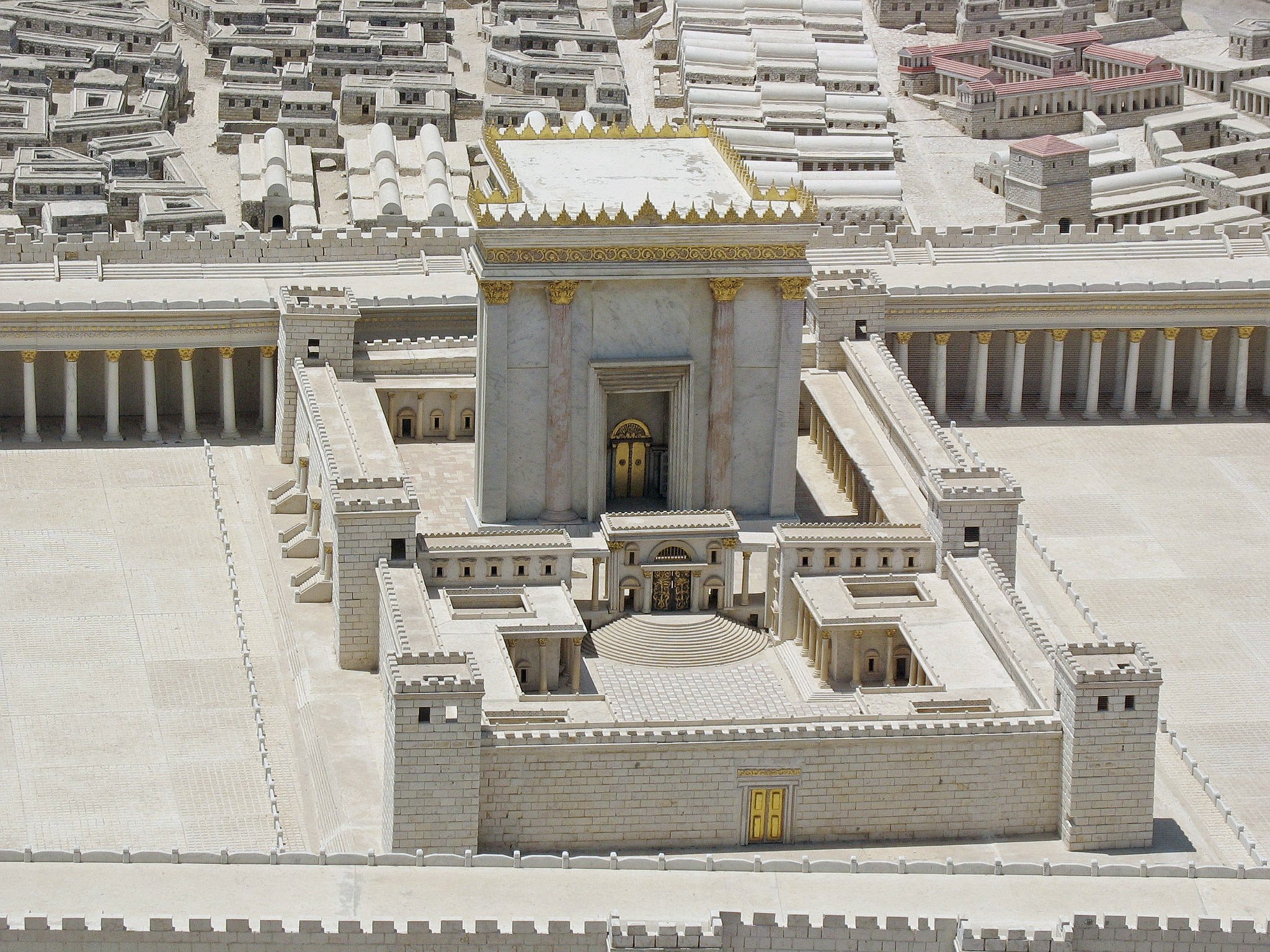
Like many tyrants, Herod was obsessed with his legacy. In 20 BCE, Herod embarked upon one of the great vanity projects of the ancient world. He rebuilt the Temple in Jerusalem, pulling down most of the old structure and restoring it at great cost. Magnificently appointed, he saw it as a breath-taking, awe-inspiring monument to his memory and a testimony to his largesse.
Herod has the remarkable distinction of being both the instigator of the most lavish reconstruction project the Temple had ever experienced and also the saboteur of its sanctity. Since biblical times, the rituals in the Temple had been conducted by a direct descendant of King David’s High Priest, Zadok. Herod put an end to this. He downgraded the office of High Priest from a hereditary office for life to a temporary contract in the gift of the king.
Anybody could now become High Priest, provided only that they came from a priestly family and were willing to pay Herod a greater bribe than their nearest rival. The High Priesthood descended from the epitome of spiritual elevation to a grubby commodity, the ultimate aspiration for anyone born into a priestly family, willing to pay the tyrant his due. Very few High Priests from Herod’s reign onwards attracted respect through the force of their own spirituality. Herod emasculated the power of the High Priesthood and weakened its status to assert himself as uncontested ruler.
The office continued to be bought and sold after Herod’s death; Josephus tells us of High Priests who kept the job for only a few months before being outbid, or who were forced to share the role with a rival. Frequently appointed by the Roman Procurator and subservient to his whims, the High Priest was looked upon as a quisling by all. Eventually, the High Priest became little more than the Romans’ man in the Temple; there were periods when Rome’s Procurator even took custody of the distinctive priestly garments.
Herod rebuilt the Temple as a memorial to himself and degraded its priesthood. When Rome destroyed the Temple, 75 years after Herod’s death, it was a spiritual and religious tragedy for the Jewish nation. But its debased stature and short life hold a different message for those who dream of vanity projects to cement their own legacy. That is, if they have any concept of history at all.